retagged by
1,878 views
2 2 votes

In a car race, car $\text{A}$ beats car $\text{B}$ by $45 \; \text{km},$ car $\text{B}$ beats car $\text{C}$ by $50 \; \text{km},$ and car $\text{A}$ beats car $\text{C}$ by $90\;\text{km}.$ The distance $\text{(in km)}$ over which the race has been conducted is 

  1. $500$
  2. $475$
  3. $550$
  4. $450$

1 Answer

1 1 vote

Given that, in a car race, $\text{car A}$ beats $\text{car B}$ by $45 \; \text{km},$ and $\text{car B}$ beats $\text{car C}$ by $50 \; \text{km},$ and $\text{car A}$ beats $\text{car C}$ by $90 \; \text{km}.$

Let the distance over which the race has been conducted be $`x\text{’} \; \text{km}.$

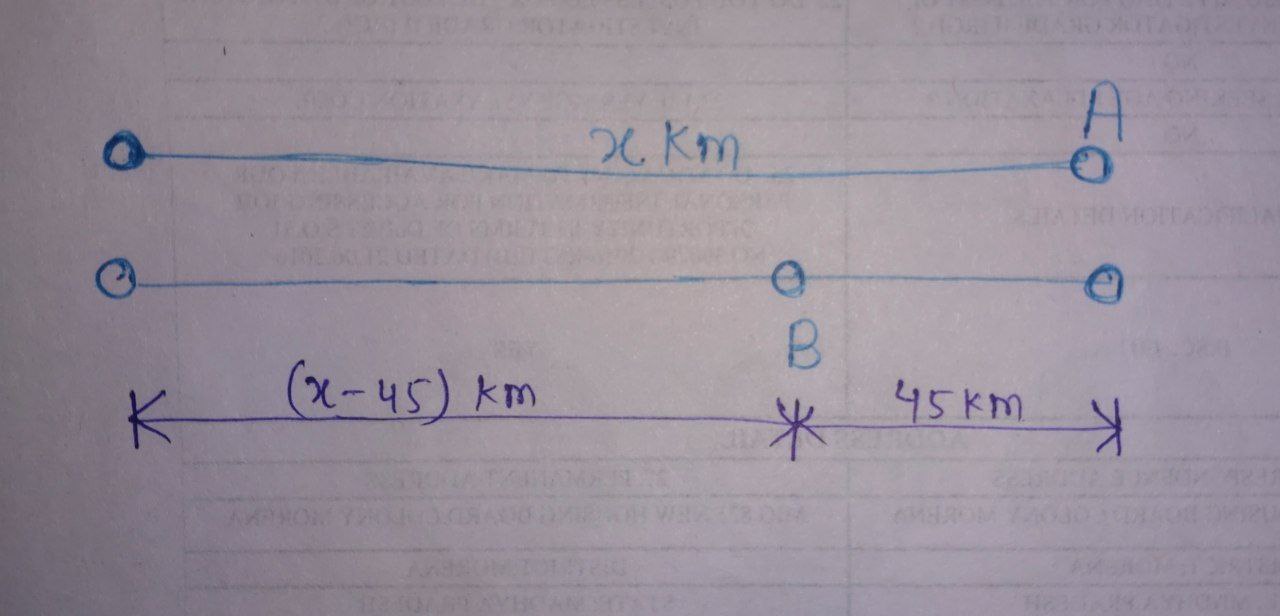
$\textbf{Case 1:}$
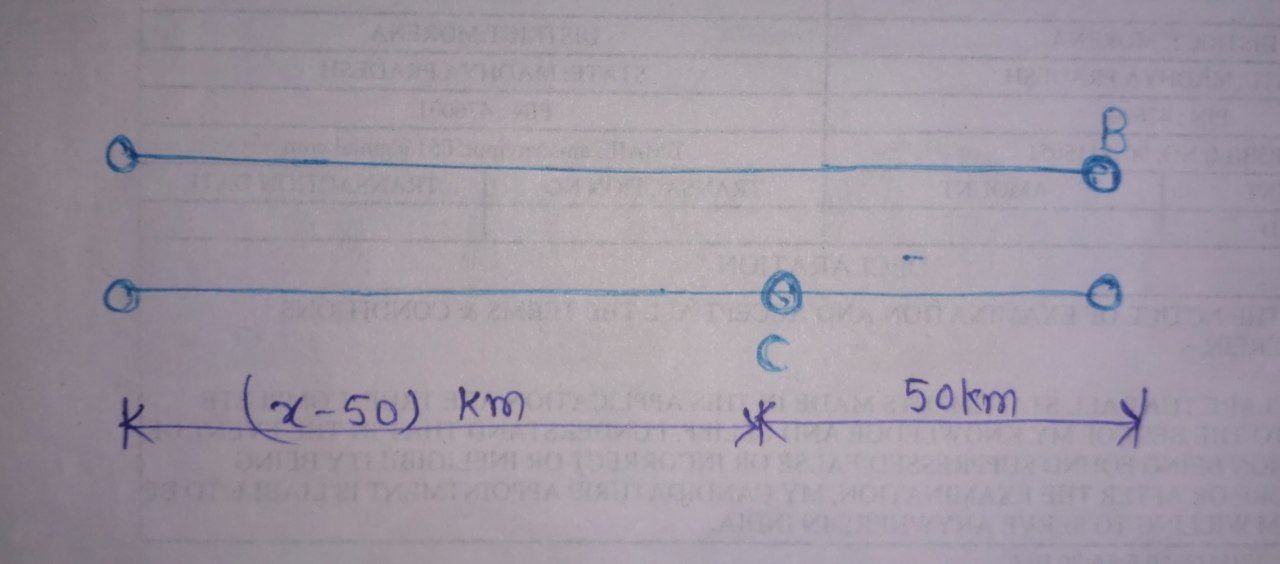
$\textbf{Case 2:}$
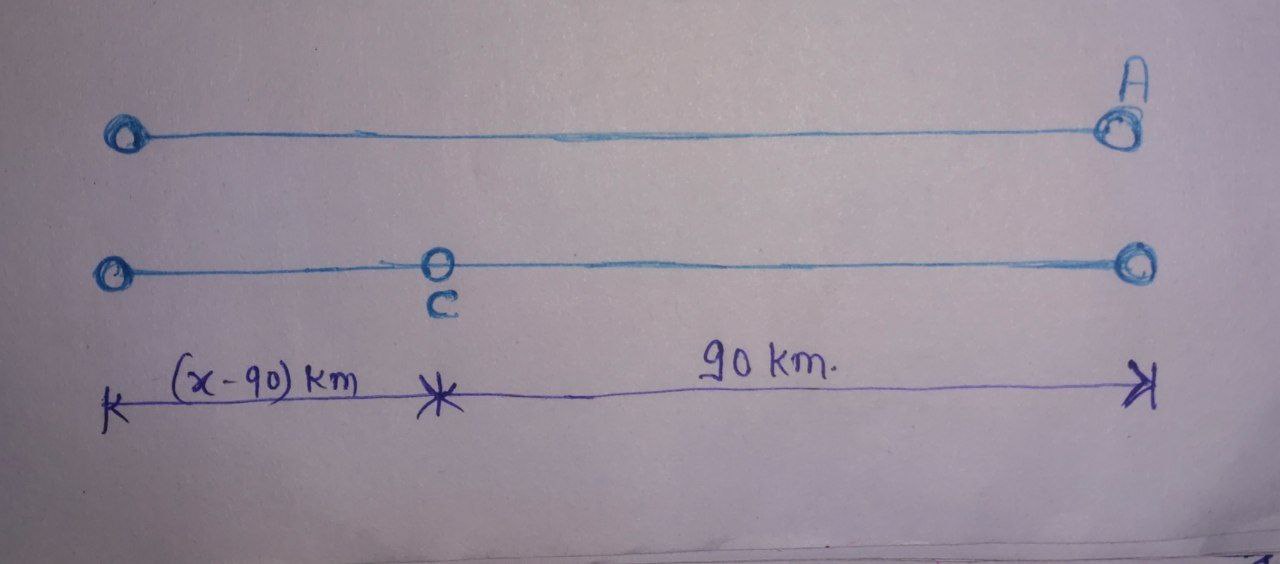
$\textbf{Case 3:}$
We know that, $ \text{Speed} = \frac{\text{Distance}}{\text{Time}} $

$\Rightarrow \boxed {\text{Speed} \propto \text{Distance}} \; (\text{Time = constant})$

Now, we can calculate the ratios of speed: 

  • In $\textbf{Case 1: } \frac{S_{A}}{S_{B}} = \frac{x}{x – 45} \quad \longrightarrow (1) $
  • In $\textbf{Case 2: } \frac{S_{B}}{S_{C}} = \frac{x}{x – 50} \quad \longrightarrow (2) $
  • In $\textbf{Case 3: }  \frac{S_{A}}{S_{C}} = \frac{x}{x – 90} \quad \longrightarrow (3) $ 

Now, multiply equation $(1) \;\&\; (2),$ we get 

$\left( \frac{S_{A}}{S_{B}} \right) \times \left( \frac{S_{B}}{S_{C}} \right) = \left( \frac{x}{x-45} \right) \left( \frac{x}{x-50} \right) $

$ \Rightarrow \frac{S_{A}}{S_{C}} = \frac{x^{2}}{(x-45)(x-50)} $

$ \Rightarrow \frac{x}{x-90} = \frac{x^{2}}{(x-45)(x-50)}  \quad [\because \text{From equation (3)}]$

$ \Rightarrow (x-45)(x-50) = x(x-90) $

$ \Rightarrow x^{2} – 50x – 45x + 2250 = x^{2} – 90x $

$ \Rightarrow – 95x + 90x = – 2250 $

$ \Rightarrow -5x = -2250 $

$ \Rightarrow x = \frac{2250}{5} $

$ \Rightarrow \boxed{x = 450 \; \text{km}}$

$\therefore$ The distance (in km) over which the race has been conducted is $450.$

Correct Answer$: \text{D}$

edited by
Position:
Show:
Answer:

Related questions

2 2 votes
1 answers 1 answer
1.9k
1.9k views
soujanyareddy13 asked Sep 17, 2021
1,932 views
Two circular tracks $\text{T}1$ and $\text{T}2$ of radii $100 \; \text{m}$ and $20 \; \text{m},$ respectively touch at a point $\text{A}.$ Starting from $\text{A}$ at the...
2 2 votes
1 1 answer
2.2k
2.2k views
soujanyareddy13 asked Sep 17, 2021
2,164 views
$\text{A}$ and $\text{B}$ are two points on a straight line. Ram runs from $\text{A}$ to $\text{B}$ while Rahim runs from $\text{B}$ to $\text{A}.$ After crossing each ot...
2 2 votes
1 1 answer
1.9k
1.9k views
soujanyareddy13 asked Sep 17, 2021
1,947 views
The distance from $\text{B}$ to $\text{C}$ is thrice that from $\text{A}$ to $\text{B}.$ Two trains travel from $\text{A}$ to $\text{C}$ via $\text{B}.$ The speed of trai...
1 1 vote
1 1 answer
1.9k
1.9k views
soujanyareddy13 asked Sep 17, 2021
1,944 views
$\text{A}$ and $\text{B}$ are two railway stations $90 \; \text{km}$ apart. A train leaves $\text{A}$ at $9:00 \; \text{am},$ heading towards $\text{B}$ at a speed of $40...
2 2 votes
1 1 answer
1.9k
1.9k views
soujanyareddy13 asked Sep 17, 2021
1,914 views
​​​​​​​​​​​​​​​​​​​​​​​​​​​​The sum of the perimeters of an equilateral triangle and a rectangle is $90 \; \text{cm}.$ The area, $\text{T},$ of the triangle and the area,...