• retagged by
1,480 views
2 2 votes

In a circle, two parallel chords on the same side of a diameter have lengths $4$ cm and $6$ cm. If the distance between these chords is $1$ cm, then the radius of the circle, in cm, is

  1. $\sqrt{12}$
  2. $\sqrt{14}$
  3. $\sqrt{13}$
  4. $\sqrt{11}$

1 Answer

1 1 vote

Given that, the length of long chord is $6 \; \text{cm},$  the length of small chord is $4 \; \text{cm},$ and the distance between these chords is $1\;\text{cm}.$

Let the radius of the circle be $ `r\text{’} \; \text{cm},$ and let the distance of long chord from the center of circle be $ `k\text{’} \; \text{cm}.$

We can draw the diagram,
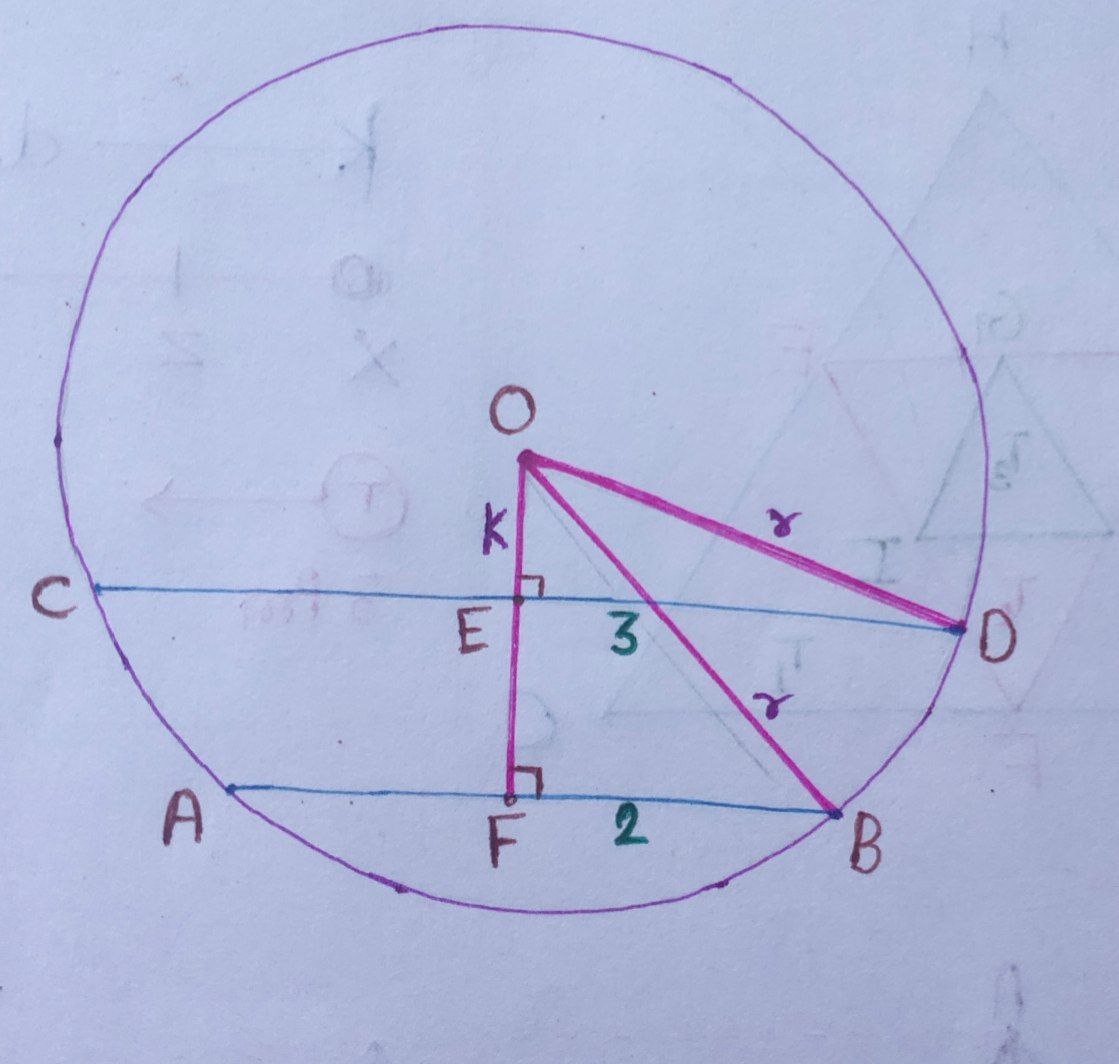


We know that the perpendicular from the center of the circle to the chords bisects the chords.

In $\triangle \text{OFB},$ apply the Pythagoras’ theorem :

$ \text{(OB)}^{2} = \text{(OF)}^{2} + \text{(FB)}^{2}$

$ \Rightarrow r^{2} = (k+1)^{2} + 2^{2}$

$ \Rightarrow r^{2} = k^{2} + 1 + 2k + 4$

$ \Rightarrow r^{2} = k^{2} + 2k + 5 \quad \longrightarrow (1)$

In $ \triangle \text{OED},$ apply the Pythagoras’ theorem :

$ \text{(OD)}^{2} = \text{(OE)}^{2} + \text{(ED)}^{2}$

$ \Rightarrow r^{2} = k^{2} + 3^{3} $

$ \Rightarrow r^{2} = k^{2} + 9 \quad \longrightarrow (2)$

On equating the equation $(1),$ and $(2),$ we get,

$ k^{2} + 2k + 5 = k^{2} + 9 $

$ \Rightarrow 2k = 4 $

$ \Rightarrow \boxed {k= 2 \;\text{cm}}$  

Put the value of $k$ in equation $(2),$ we get,

$ r^{2} = 2^{2} + 9$

$ \Rightarrow r^{2} = 4 + 9$

$ \Rightarrow r^{2} = 13$

$\Rightarrow \boxed { r = \sqrt{13}\; \text{cm}}$

$\therefore$ The radius of the circle is $\sqrt{13}\;\text{cm}.$

Correct Answer $: \text{C}$

• edited by
Position:
Show:
Answer:

Related questions

2 2 votes
1 1 answer
1.7k
1.7k views
go_editor asked Mar 19, 2020
1,653 views
Given an equilateral triangle $\text{T1}$ with side $24$ cm, a second triangle $\text{T2}$ is formed by joining the midpoints of the sides of $\text{T1}$. Then a third tr...
2 2 votes
1 answers 1 answer
2.1k
2.1k views
go_editor asked Mar 19, 2020
2,111 views
Points $\text{E, F, G, H}$ lie on the sides $\text{AB, BC, CD}$, and $\text{DA}$, respectively, of a square $\text{ABCD}$. If $\text{EFGH}$ is also a square whose area is...
2 2 votes
1 1 answer
1.8k
1.8k views
go_editor asked Mar 19, 2020
1,817 views
Let $\text{ABCD}$ be a rectangle inscribed in a circle of radius $13$ cm. Which one of the following pairs can represent, in cm, the possible length and breadth of $\text...
2 2 votes
1 1 answer
1.4k
1.4k views
go_editor asked Mar 19, 2020
1,445 views
In a parallelogram $\text{ABCD}$ of area $72$ sq cm, the sides $\text{CD}$ and $\text{AD}$ have lengths $9$ cm and $16$ cm, respectively. Let $\text{P}$ be a point on $\t...
2 2 votes
1 1 answer
1.8k
1.8k views
go_editor asked Mar 19, 2020
1,812 views
In a circle with center $\text{O}$ and radius $1$ cm, an arc $\text{AB}$ makes an angle $60$ degrees at $\text{O}$. Let $\text{R}$ be the region bounded by the radii $\te...