• edited by
1,829 views

1 Answer

1 1 vote

Given that,

  • $2x+3y-5=0 \longrightarrow(1)$
  • $5x-7y+2=0 \longrightarrow(2)$
  • $9x-5y-4=0 \longrightarrow(3)$

Take equation $(1)$ and $(2).$

            $2x+3y-5=0 \longrightarrow(1)\times7$

            $5x-7y+2=0 \longrightarrow(2)\times3$

            $14x+21y-35=0$

            $15x-21y+6=0$

           ----------------------------------

            $29x-29=0$

            $\boxed{x=1}$

Put the value of $’x’$ in equation $(1)$,we get.

$2(1)+3y-5=0$

$\Rightarrow 3y=3$ 

$\Rightarrow \boxed{y=1}$ 

Take equation $(1)$ and $(3).$

         $2x+3y-5=0 \longrightarrow(1)\times5$

         $9x-5y-4=0 \longrightarrow(3)\times3$

         $10x+15y-25=0$

         $27x-15y-12=0$

         ----------------------------------

            $37x-37=0$

            $\Rightarrow\boxed{x=1}$

Put the value of $’x’$ in equation $(3)$,we get.

$9(1)-5y-4=0$

$\Rightarrow -5y+5=0$ 

$\Rightarrow \boxed{y=1}$ 

Take equation $(2)$ and $(3).$

         $5x-7y+2=0 \longrightarrow(2)\times5$

         $9x-5y-4=0 \longrightarrow(3)\times7$

         $25x-35y+10=0$

         $63x-35y-28=0$

         ----------------------------------

            $-38x+38=0$

            $\Rightarrow\boxed{x=1}$

Put the value of $’x’$ in equation $(2)$,we get.

$5(1)-7y+2=0$

$\Rightarrow -7y+7=0$ 

$\Rightarrow \boxed{y=1}$ 

We can say that, these three lines meet at point $M(x,y)=M(1,1).$
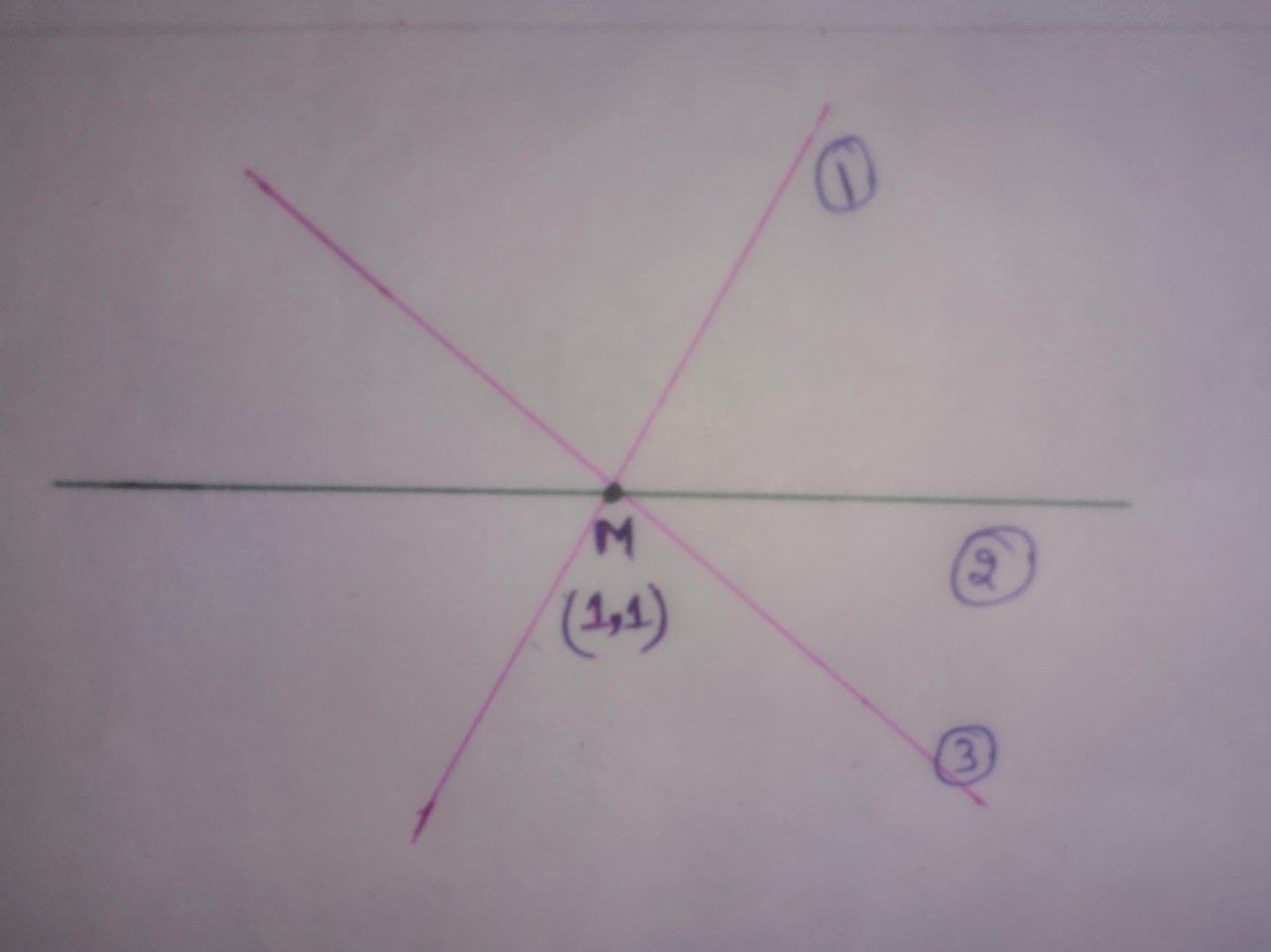
$\therefore$ These three lines are coincident.

Correct Answer $;\text{D}$

• edited by
Position:
Show:
Answer:

Related questions

0 0 votes
0 0 answers
1.3k
1.3k views
go_editor asked Mar 11, 2020
1,253 views
Direction for questions: Answer the questions based on the following information.In a locality, there are five small cities: $\text{A, B, C, D}$ and $\text{E}$. The dista...
1 1 vote
1 1 answer
2.0k
2.0k views
go_editor asked Mar 11, 2020
1,954 views
From a circular sheet of paper with a radius $20\:\text{cm}$, four circles of radius $5\:\text{cm}$ each are cut out. What is the ratio of the uncut to the cut portion?$1...
0 0 votes
0 0 answers
1.8k
1.8k views
soujanyareddy13 asked Sep 17, 2021
1,846 views
The vertices of a triangle are $(0,0), (4,0)$ and $(3,9).$ The area of the circle passing through these three points is $\frac{14 \pi}{3}$$\frac{12 \pi}{5}$$\frac{123 \pi...
0 0 votes
0 0 answers
1.2k
1.2k views
soujanyareddy13 asked Sep 17, 2021
1,194 views
The points $(2,1)$ and $( – 3, – 4)$ are opposite vertices of a parallelogram. If the other two vertices lie on the line $x + 9y + c = 0,$ then $\text{c}$ is $12$$14$$13$...
2 2 votes
1 1 answer
1.9k
1.9k views
go_editor asked Mar 8, 2020
1,861 views
With rectangular axes of coordinates, the number of paths from $(1,1)$ to $(8,10)$ via $(4,6)$, where each step from any point $(x,y)$ is either to $(x,y+1)$ or to $(x+1,...