• edited by
4,946 views
1 1 vote

Consider a square $\text{ABCD}$ with midpoints $\text{E, F, G, H}$ of $\text{AB, BC, CD}$ and $\text{DA}$ respectively. Let $\text{L}$ denote the line passing through $\text{F}$ and $\text{H}.$ Consider points $\text{P}$ and $\text{Q},$ on $\text{L}$ and inside $\text{ABCD},$ such that the angles $\text{APD}$ and $\text{BQC}$ both equal $120^{\circ}$. What is the ratio of the area of $\text{ABQCDP}$ to the remaining area inside $\text{ABCD}?$

  1. $\frac{4 \sqrt{2} } {3}$
  2. $2 + \sqrt{3}$
  3. $\frac{10-3 \sqrt{3} } {9} $
  4. $1+ \frac{1}{\sqrt{3} }$
  5. $2 \sqrt{3} -1$

1 Answer

Best answer
1 1 vote

$5^{th}$ option must be the right one.

Here is the diagram of square $ABCD$
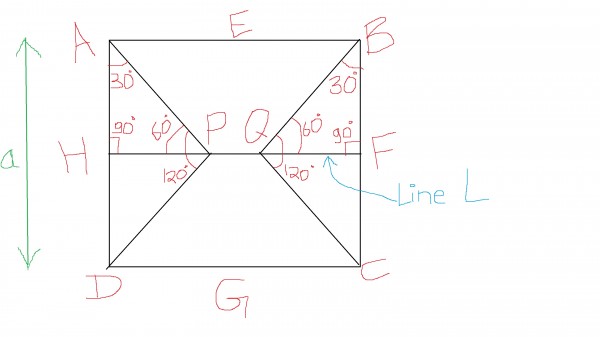
Consider the side length of the square be $a$ units.

Then $AH = BF = \frac{a}{2}$

From the rectangle $ABFH$, 

$\angle AHP = \angle BFQ = 90^{\circ}.$

Now since $HF$ is the perpendicular bisector of $DA$ and $BC$, 

$\angle APH = \frac{1}{2}\angle APD = 60^{\circ}$ and

$\angle BQF = \frac{1}{2}\angle BQC = 60^{\circ}$.

Hence $\angle PAH = \angle QBF = 30^{\circ}.$


Area of $\Delta APD =$ Area of $\Delta BQC = 2\left ( \frac{1}{2}\times \frac{a}{2} \times \frac{a}{2} \tan\left ( 30^{\circ} \right ) \right ) $ 

The area of region $ABQCDP$ = Area of square $ABCD - $ (Area of triangle $APD$ $+$ Area of triangle $BQC$).

so area of the region  $ABQCDP$

$= a^{2} - \left ( 2\left ( \frac{1}{2}\times \frac{a}{2} \times \frac{a}{2} \tan\left ( 30^{\circ} \right ) \right ) + 2\left ( \frac{1}{2}\times \frac{a}{2} \times \frac{a}{2} \tan\left ( 30^{\circ} \right ) \right ) \right )$

$= a^{2} - \left ( \frac{a^{2}}{2\sqrt3}\right ). $

$= a^{2}\left ( 1 - \frac{1}{2\sqrt3}  \right )$

Area of the region left after removing the area of $ABQCDP$

$= a^{2} - a^{2}\left ( 1 - \frac{1}{2\sqrt3}  \right ) =\frac{a^{2}}{2\sqrt3} $.

Hence the required ratio $= \frac{a^{2}\left ( 1 - \frac{1}{2\sqrt3}  \right )}{\frac{a^{2}}{2\sqrt3}}.$

On simplifying, this will give $\left ( 2\sqrt3 - 1 \right ).$


• selected by
Position:
Show:

Related questions

0 0 votes
0 0 answers
1.4k
1.4k views
go_editor asked Nov 29, 2015
1,406 views
Two circles, both of radii $1$ cm, intersect such that the circumference of each one passes through the centre of the other. What is the area (in sq cm) of the intersecti...
1 1 vote
1 answers 1 answer
2.6k
2.6k views
go_editor asked Nov 28, 2015
2,569 views
Consider obtuse-angled triangles with sides $8$ cm, $15$ cm and $x$ cm. If x is an integer, then how many such triangles exist?$5$$21$$10$$15$$14$
0 0 votes
1 1 answer
1.4k
1.4k views
go_editor asked Nov 28, 2015
1,404 views
In a triangle $\text{ABC}$, the lengths of the sides $\text{AB}$ and $\text{AC}$ equal $17.5$ cm and $9$ cm respectively. Let $\text{D}$ be a point on the line segment $\...
0 0 votes
1 1 answer
1.9k
1.9k views
go_editor asked Apr 30, 2016
1,859 views
Let $f(x) = ax^2 + bx +c$, where $a, b$ and $c$ are certain constants and $a \neq 0$. It is known that $f(5) = -3 f(2)$ and that $3$ is a root of $f(x)=0$.What is the val...
0 0 votes
1 1 answer
3.8k
3.8k views
go_editor asked Apr 30, 2016
3,774 views
Answer the following question based on the information given below.The bar chart shows the revenue received, in million US Dollars (USD), from subscribers to a particular...