• edited by
6,170 views
1 1 vote

Answer the question on the basis on the basis of the information given below.
Consider three circular parks of equal size with centres at $A_1,\:\: A_2,\:\:$ and $A_3$ respectively. The parks touch each other at the edge as shown in the figure (not drawn to scale). There are three paths formed by the triangles $A_1, \: A_2, \: A_3,\: B_1, \: B_2, \: B_3$, and $C_1, \: C_2, \: C_3,$ as shown. Three sprinters A, B, and C begin running from points $A_1,\: B_1$ and $C_1$ respectively. Each sprinter traverses her respective triangular path clockwise and returns to her starting point.
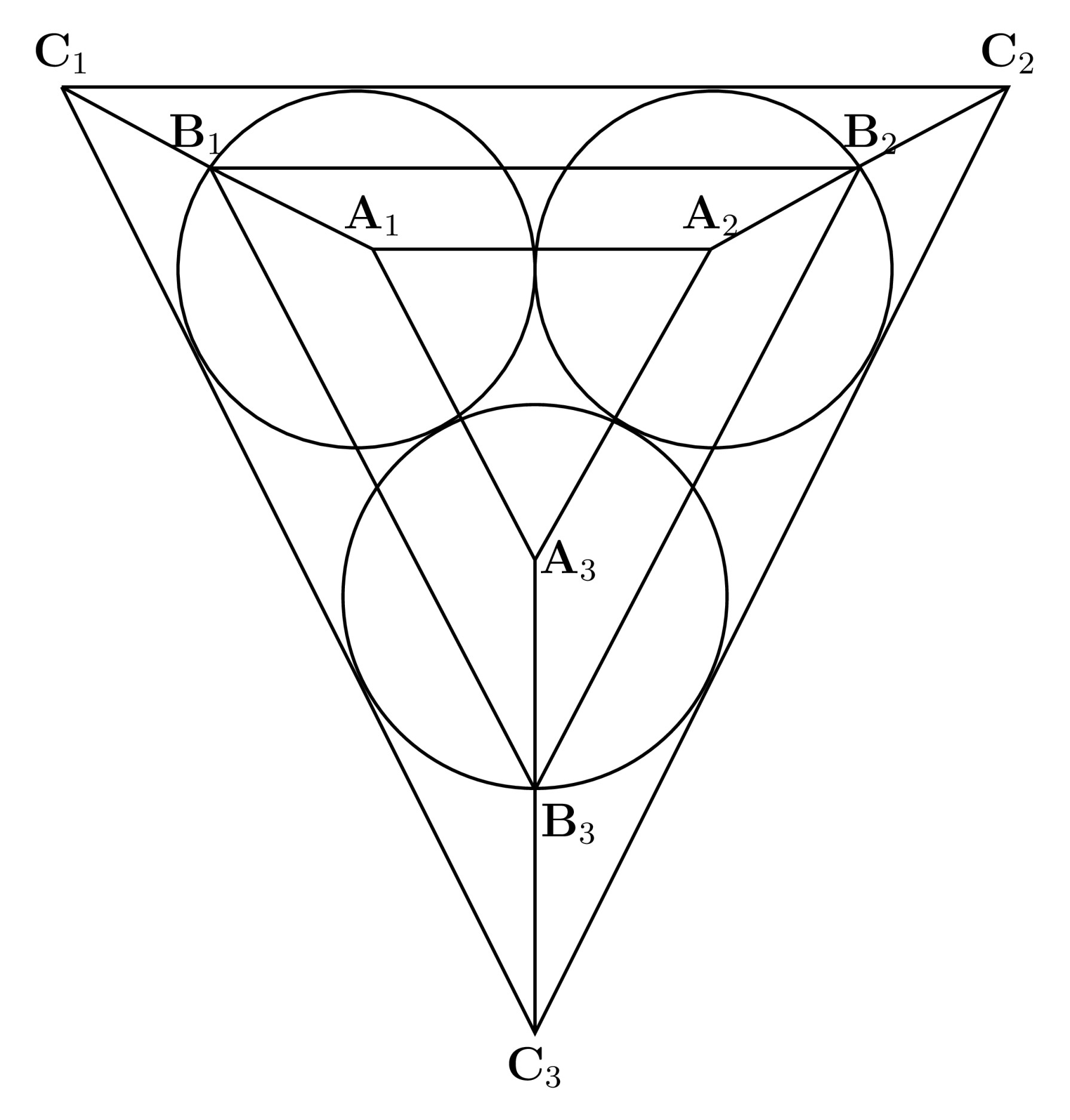
Let the radius of each circular park be $r,$ and the distances to be traversed by the sprinters A, B and C be $a, b$ and $c,$ respectively. Which of the following is true? 

  1. $b-a = c-b = 3 \sqrt{3} r$
  2. $b-a = c-b = \sqrt{3} r$
  3. $b= \frac{a+c}{2}=2(1+\sqrt{3})r$
  4. $c=2b-a=(2+\sqrt{3}r$

Please log in or register to answer this question.

Position:
Show:

Related questions

0 0 votes
0 0 answers
1.3k
1.3k views
go_editor asked May 5, 2016
1,263 views
Let $S_1$ be a square of side a. Another square $S_2$ is formed by joining the mid-points of the sides of $S_1$. The same process is applied to $S_2$ to form yet another ...
0 0 votes
0 0 answers
1.2k
1.2k views
go_editor asked May 5, 2016
1,182 views
In the figure given below (not drawn to scale), $\text{A, B}$ and $\text{C}$ are three points on a circle with centre $\text{O}.$ The chord $\text{BA}$ is extended to a p...
0 0 votes
0 0 answers
1.5k
1.5k views
go_editor asked May 5, 2016
1,521 views
In the figure below (not drawn to scale), rectangle $\text{ABCD}$ is inscribed in the circle with centre at $\text{O}.$ The length of side $\text{AB}$ is greater than tha...
0 0 votes
0 0 answers
1.3k
1.3k views
go_editor asked May 5, 2016
1,308 views
Consider two different cloth-cutting processes. In the first one, $n$ circular cloth pieces are cut from a square cloth piece of side $a$ in the following steps: the orig...
0 0 votes
0 0 answers
1.1k
1.1k views
go_editor asked May 5, 2016
1,130 views
In the figure (not drawn to scale) given below, if $\text{AD = CD = BC},$ and $\measuredangle \text{BCE} = 96^{\circ}$, how much is $\measuredangle \text{DBC}?$$32^{\cir...